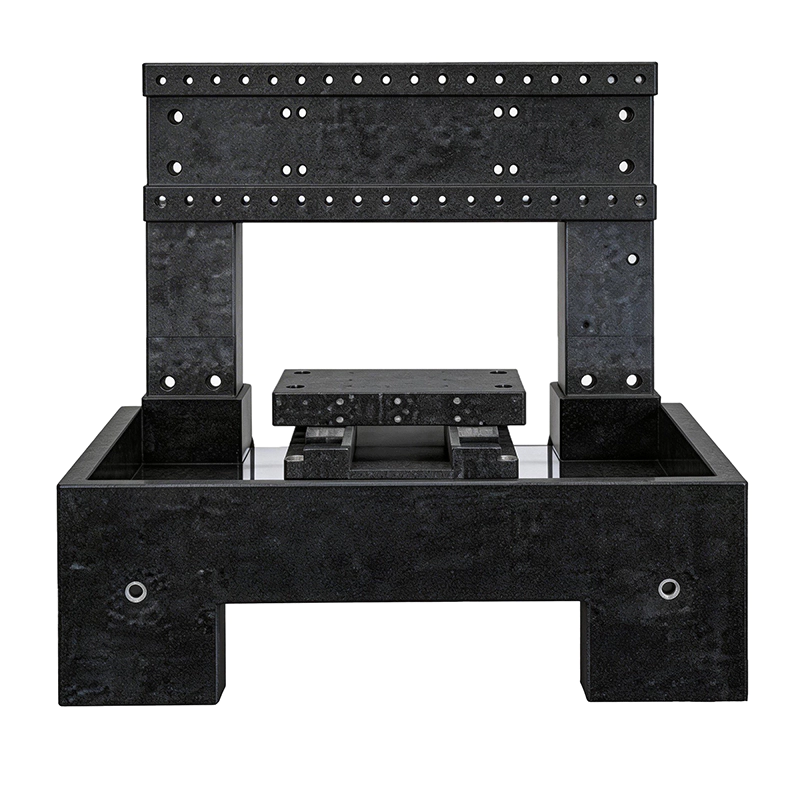
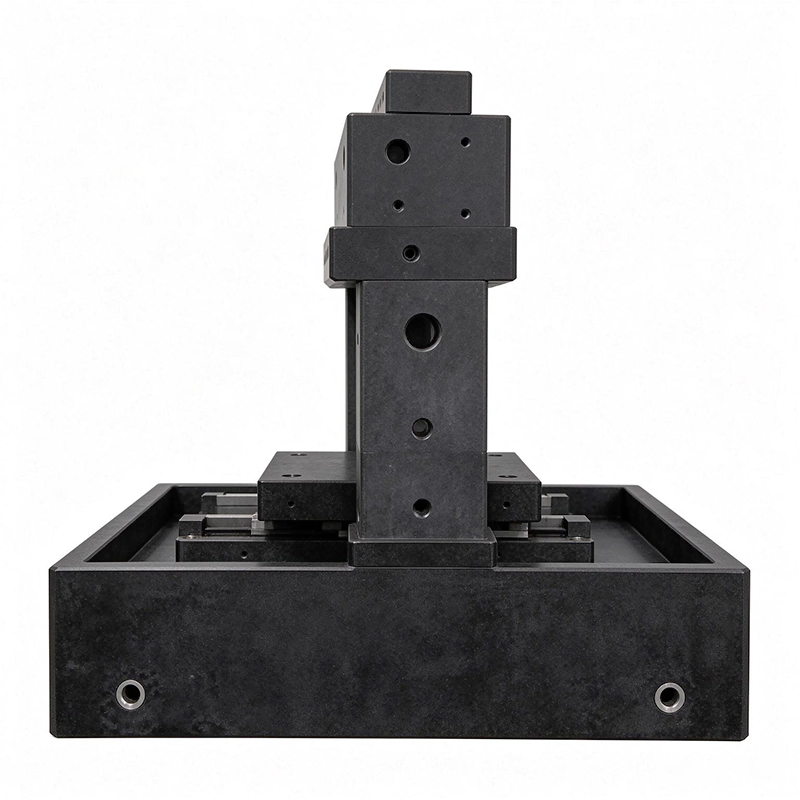
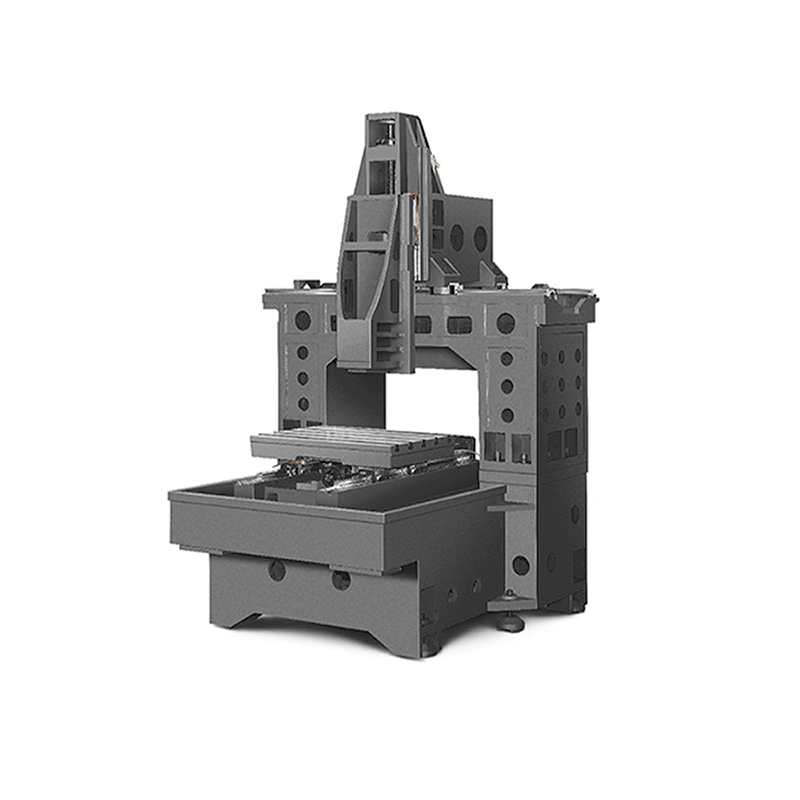
The frame — tray base, twin columns, crossbeam and centre stage mounting — is cast from mineral casting in one unified process, with no bolted-on parts and no weld seams. Steel inserts, anchor points and through-holes are cast directly into the structure, positioned from your drawing.
Unlike a cast-iron frame, a mineral casting frame is poured at room temperature: it carries no thermal internal stress, needs no annealing, and never relaxes over the machine’s life. After curing, the two beam guide faces and the stage mounting surface are precision-ground, so the linear rails and the workpiece stage reference the same monolithic structure.
With damping up to 10× that of cast iron and thermal conductivity of only ≈ 1/20 of cast iron, the frame absorbs process vibration at the source and reacts slowly and evenly to shop temperature changes — the physical foundation for smooth motion, fine finishes and stable accuracy over long, unattended runs.
Every frame is built to the customer’s drawing: overall size, beam span, hole patterns, insert sizes and stage layout are set in the mold, not machined in afterwards.
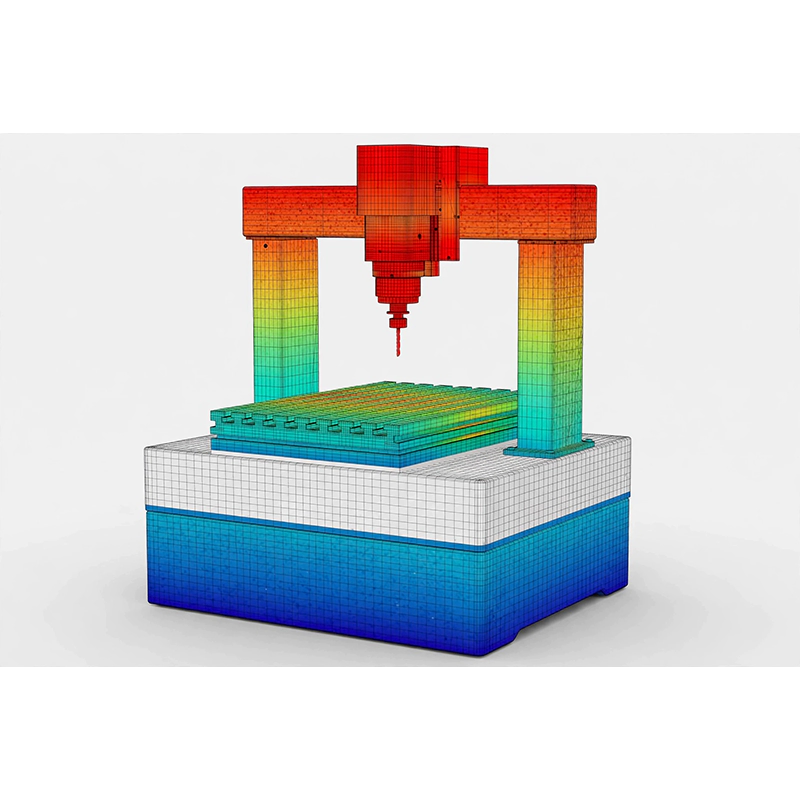
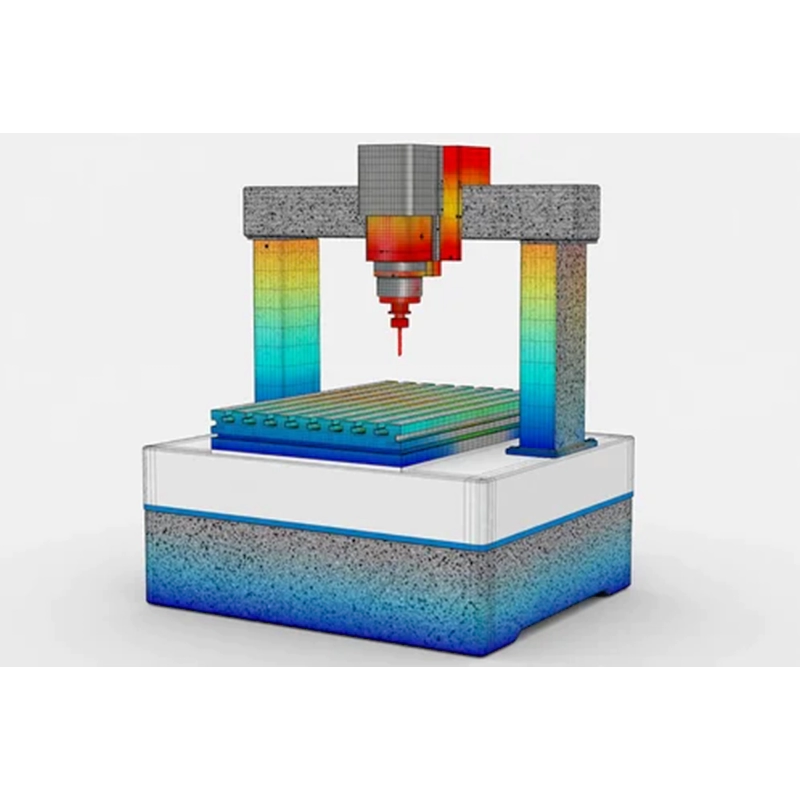
Each gantry frame configuration is verified by finite element analysis (FEM) in three load domains — static stiffness, modal dynamics and thermal behaviour — before the mold is built. The objective is not only to validate the structure under operating conditions, but to quantify its reserves under significantly elevated loads.
Process forces several times the expected operating loads are applied at the beam and head interfaces, with deformations evaluated at the linear-guide mounting points, exactly where the frame must prove its stiffness. Rib layout, wall thickness and column section are iterated until the guide faces stay within the project’s deflection budget in X, Y and Z.
The first structural modes — gantry rocking, column bending and beam torsion — are checked against servo bandwidth and process excitation for the target application, and the frame’s high material damping (logarithmic decrement 0.02–0.03 vs. 0.003 for cast iron) settles residual vibration in a fraction of the time.
Spindle- and motor-interface drift is simulated under ambient change and top-to-bottom gradients over a full 8-hour shift. The frame’s high thermal inertia (specific heat ≈ 2× cast iron, conductivity ≈ 1/20) flattens short temperature swings before they can reach the workpiece.
Conclusion: the FEM verification is issued with each project — stiffness reserves, mode shapes and thermal drift for your exact frame geometry, before any material is poured.
| Parameter | Mineral Casting Gantry Frame |
|---|---|
| Construction | One-piece mineral casting (epoxy granite): tray base, twin columns, crossbeam and stage seat in a single pour |
| Overall size / beam span | Built to customer drawing |
| Guide faces | Two ground faces on the crossbeam, full rows of cast-in threaded inserts for linear rails |
| Mounting patterns | Head, drive and stage patterns cast in to drawing; steel inserts throughout |
| Base | Integrated coolant / chip tray with centre cutout; anchor and levelling through-holes in the feet |
| Material damping | Logarithmic decrement 0.02–0.03 (cast iron: 0.003) — up to 10× the damping of cast iron |
| Thermal conductivity | ≈ 1/20 of cast iron; specific heat ≈ 2× cast iron |
| Internal stress | None — cold-cast at room temperature, no annealing, no stress relaxation over life |
| Surface finish of guide faces | Precision-ground after curing; flatness grade per customer specification |
| Options | Cast-in cable channels and coolant lines, additional insert patterns, pre-fitted levelling elements, surface coating in customer colour |
| Delivered with | flatness inspection report for the ground faces |
Material values are typical published values for mineral casting (epoxy granite) and are stated for comparison with cast iron.
Share your application, drawing or dimensional requirements with our team.